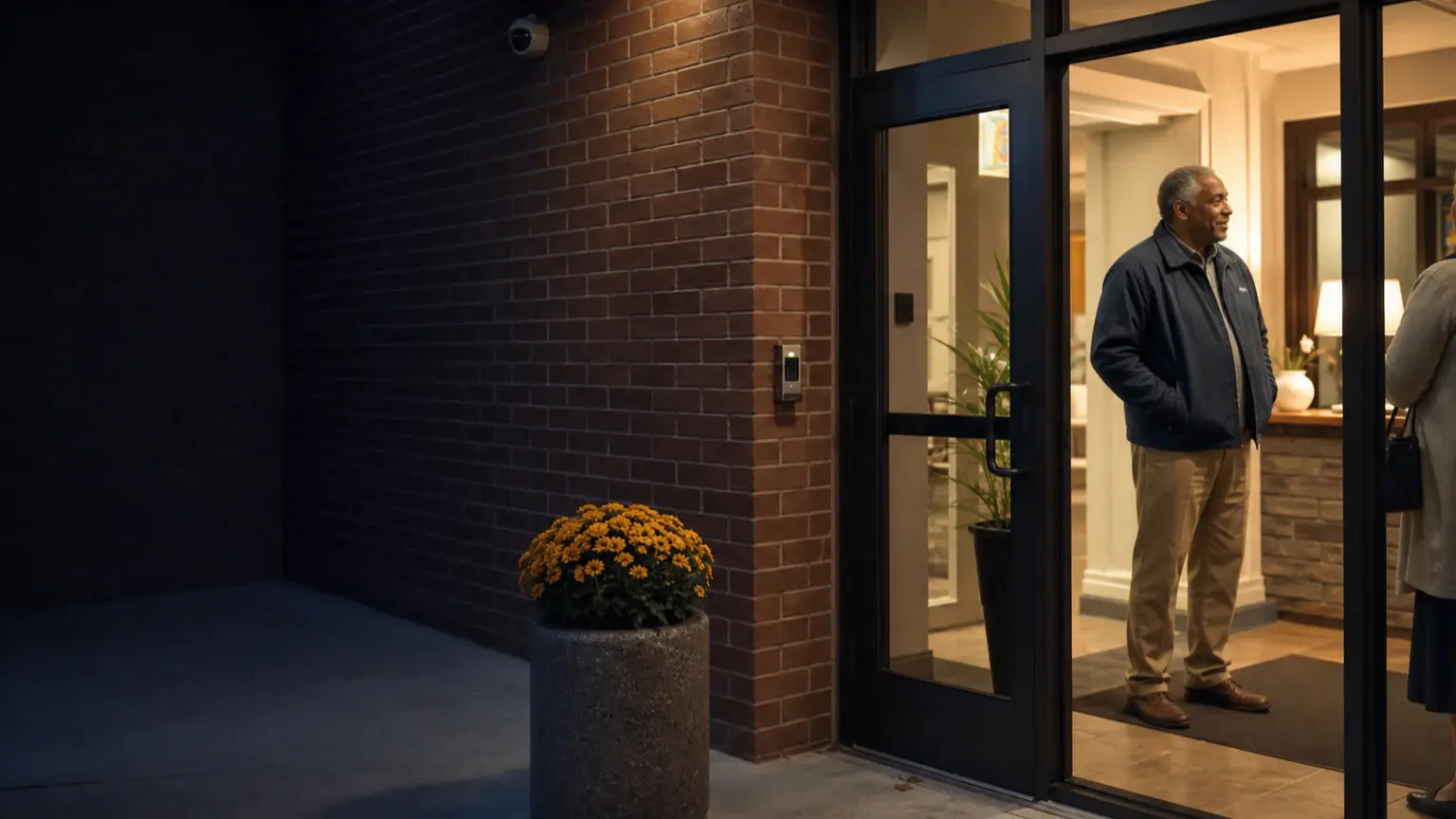
Cameras, guards, hardened entrances, and volunteer teams all affect coverage. We help align security plans, carrier requirements, and insurance protection.
What this covers
Where security and insurance intersect.
Four areas where a congregation's choices and its policy need to be reconciled.
Grant-funded improvements
Nonprofit security grant programs have funded doors, film, cameras, lighting, fencing, and access control at congregations across the country. That equipment is now property the congregation owns, and it should be added to the schedule. Some grant programs also require evidence of insurance as a condition of the award or of reimbursement.
Guards — armed and unarmed
Contracted security brings contractual questions: who is named as additional insured, what limits does the vendor carry, and does your policy respond if their actions produce a claim. Armed security raises the stakes and some carriers restrict or decline it. Off-duty law enforcement is treated differently again, and the distinction matters.
Volunteer security teams
Many congregations rely on trained volunteers. Because they act on behalf of the organization, they should fall within the definition of insured, and their training and protocols should be documented. Whether any member is armed is a question the carrier will ask and the board should answer deliberately.
Active threat & crisis response
Specialized coverage has developed for violent incidents, typically funding counseling, crisis management, business interruption, and additional security afterward — costs that fall outside a standard property or liability response. Where general liability may or may not answer, these forms are written for it explicitly.
Typically included
What we reconcile with your security program.
The goal is that the insurance file matches what actually happens on site.
Security equipment on the property scheduleCertificates from security vendorsAdditional insured status confirmedVolunteers within the definition of insuredWritten security protocols on fileActive-threat or crisis coverage consideredGrant compliance documentationCoordination with abuse and D&O coverageNot sure? Ask us
Where policies fall short
The security-related gaps we find.
Usually a communication gap rather than a coverage gap.
01
Grant equipment never added to the policy
Tens of thousands of dollars of hardware installed and uninsured because nobody told the agent the grant was awarded.
02
A guard vendor with no certificate on file
No evidence of their coverage, no additional insured status, and no contract terms allocating responsibility.
03
Armed volunteers the carrier does not know about
A material fact for underwriting. Discovering it at claim time is bad for everyone, and some carriers would have declined or priced differently.
04
No crisis response coverage
Counseling, crisis management, and the security costs that follow an incident are real and are frequently outside standard forms.
Common questions
Security questions from boards.
Increasingly the first topic at annual reviews.
We received a security grant. What do we need to do?
Tell us what was funded and installed. The equipment belongs on the property schedule, and some programs require proof of insurance for the award or for reimbursement. It is a short conversation that prevents an uninsured asset and a compliance problem at once.
Does hiring armed security affect our coverage?
It can affect both eligibility and price, and carriers differ considerably. Contracted licensed security, off-duty law enforcement, and armed volunteers are treated as three different things. Tell us which you are using before you commit to a vendor.
Are our volunteer security team members covered?
They should be, as volunteers acting for the congregation, but it depends on how the policy defines an insured. It is worth confirming explicitly, along with documenting training and protocols.
Is there coverage for the aftermath of a violent incident?
Standalone active-threat and crisis-response products exist and are written for exactly the costs a standard policy handles poorly — counseling, crisis communications, temporary relocation, and additional security. Worth pricing for any congregation.
Our review
What we review alongside your security plan.
Grant awards and what was installed
Security equipment on the property schedule
Vendor contracts and certificates
Additional insured and indemnity wording
Volunteer team structure and training records
Whether anyone on site is armed
Active-threat and crisis-response options
Coordination with D&O and abuse coverage
Tell us what changed on site this year.
Security decisions move faster than renewals. A short update keeps the policy matched to the building.